


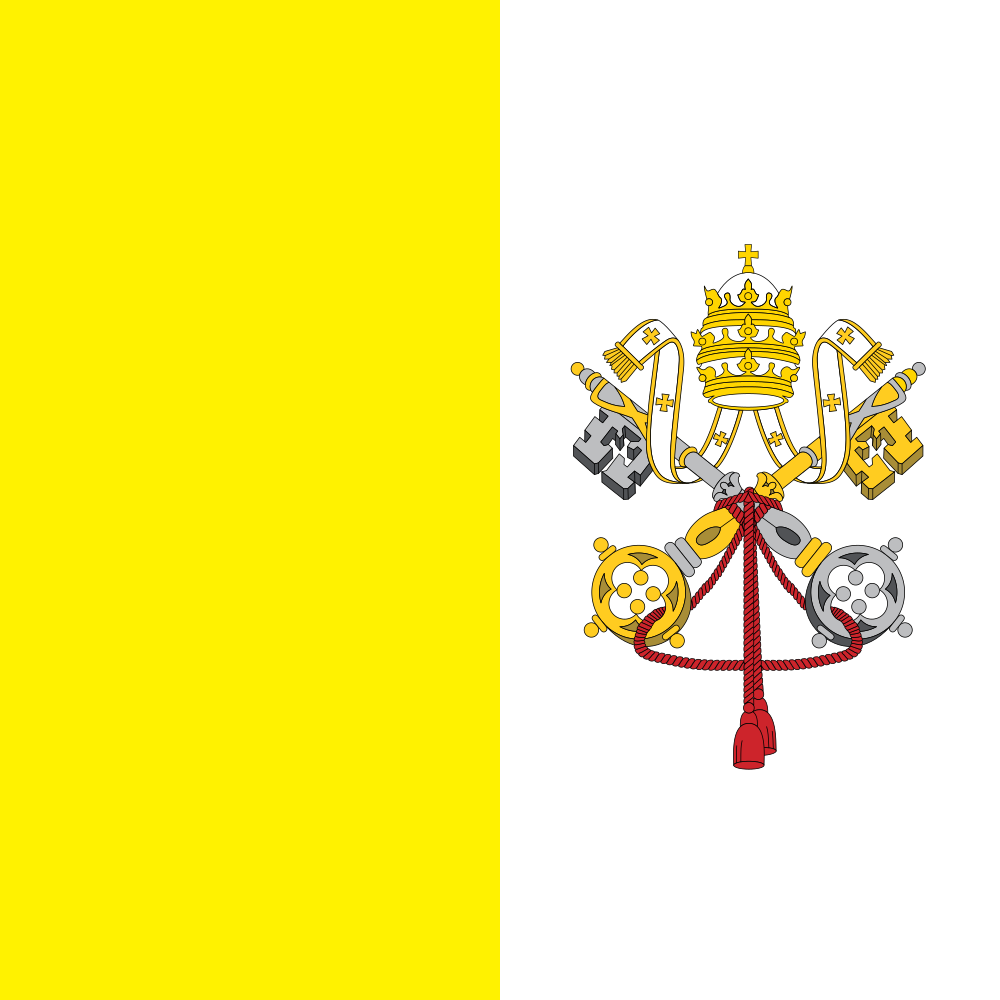

Vatican City passport holders have needed a UK ETA since April 2025. Two years of validity, multiple entries, up to six months in Britain per visit — applied for online in minutes.
6 months
Maximum stay per visit
2 years
ETA validity
Multiple
Entries permitted
3 working days
Typical decision time
100% online
No embassy visit
Overview
Vatican City is the smallest sovereign state in the world, and its passport is among the rarest documents in circulation. It is not a nationality acquired by birth or residence in the ordinary sense: Vatican citizenship is held by the Pope, cardinals resident in Rome, members of the Holy See's diplomatic service, the Swiss Guard and certain officials, and it generally lasts only as long as the office or appointment does.
Since April 2025 Vatican City passport holders have needed an Electronic Travel Authorisation for travel to Britain, in the same European phase of the rollout that brought EU and EEA nationalities into scope. Vatican City is a non-visa country for UK purposes, and nothing about what its passport holders may do in Britain has changed. The ETA is a digital pre-travel permission applied for online and linked to the passport number.
Travel from the Vatican to the United Kingdom is typically official rather than touristic — Holy See diplomatic business, ecclesiastical visits, conferences and academic engagements. The Vatican has no airport, so every journey begins at Rome Fiumicino or Ciampino, both of which have extensive services to London and the British regions. Neither the purpose of travel nor the departure airport changes the ETA requirement, which follows the passport.
At a glance
Eligibility
You do not need a visa, but you do need an ETA. Vatican City is a non-visa national country for UK purposes, so its passport holders travel to Britain as visitors for religious, academic, business or diplomatic purposes and for tourism without a consular application. The ETA precedes that permission and does not reduce it — the six months allowed to visitors is unchanged.
Every traveller needs their own ETA, linked to their own passport. There is no group or delegation application, so a party travelling together for a conference or an official visit needs an individual authorisation for each member. This is worth building into the planning for any organised visit, since it cannot be handled as a single submission.
There is an important exemption for genuinely diplomatic travel. Holders of a diplomatic or official passport travelling on Holy See business may fall under separate arrangements, and where a visit is conducted through official channels the appropriate route should be confirmed with the Holy See's own protocol office rather than assumed. For ordinary travel — a private visit, an academic engagement, a holiday — the ETA is the correct route.
Vatican City is not in the European Union or the EEA. Its passport holders are therefore not in the ePassport gate cohort and will be seen by a Border Force officer at a staffed desk on arrival. The ETA itself is identical to any other; only the arrival process differs. Many Vatican passport holders also retain their original nationality, and where that nationality is an EU one, travelling on that passport instead gives access to the automated gates.
Stay & validity
An approved ETA is valid for two years from the date it is granted, or until your Vatican passport expires, whichever comes first. Within that window there is no limit on entries, and each visit can last up to six months. For those making regular visits to Britain on ecclesiastical or academic business, one approval covering two years removes a recurring step.
The passport-expiry rule deserves particular attention here. Vatican passports are typically issued for the duration of an office or appointment rather than on a fixed ten-year cycle, and they can therefore have unusual validity periods. The ETA ends when the passport does, so a passport with a year remaining produces an ETA with a year remaining. Check the expiry date on the document itself before applying.
Britain does not require six months of onward passport validity, only that the passport covers your stay. This is more relaxed than the Schengen rule for third-country nationals.
Six months per visit is the maximum for a single entry rather than an annual allowance. Where this matters is for extended academic or ecclesiastical placements. A study period, sabbatical or residency running beyond six months requires an appropriate visa applied for in advance rather than an ETA, and that route cannot be taken up from within the UK after arriving as a visitor.
Pricing
Live fees for Vatican passport holders, shown all-in — the Home Office charge and our service fee together, with nothing added later.
Your nationality is pre-selected as Vatican City
Requirements
Everything Vatican passport holders need before starting an application. The first five items apply to every applicant; the rest are specific to your nationality.
Passport bio-data page — a clear colour scan or photo showing your photograph, full name, date of birth, passport number and expiry date
Recent digital photograph — full face visible against a plain background, taken within the last six months, with no headwear other than for religious or medical reasons
A valid email address, which is where the approval is sent and which you should keep accessible while travelling
A credit or debit card to pay the Home Office ETA fee and our service fee together
Your travel and accommodation details — Border Force can ask about the purpose of your visit and where you are staying
Simple process
Four steps, entirely online, with our team checking every field before anything reaches the Home Office.
Enter your passport details exactly as printed, answer the suitability questions and upload your photograph. Most applicants finish in under ten minutes.
Our team checks your photo, passport number, name spelling and declarations against Home Office requirements before anything is submitted.
Your application goes to UK Visas and Immigration with the government fee paid, and we track its status until a decision is issued.
There is no sticker, label or document to print. The authorisation is held digitally against your passport number, and we explain exactly what to show at check-in.
Applications are decided automatically in most cases, with approval frequently arriving within minutes. The Home Office asks travellers to allow up to three working days, and a proportion are referred for manual review, usually where a photograph fails the automated check.
Apply at least a week before travelling, and earlier for an organised visit. Because every member of a travelling party needs an individual authorisation and there is no group submission, a delegation of any size should begin collecting passport details well in advance rather than in the final days.
One point specific to this passport: it is issued in very small numbers, and some airline check-in systems and online forms handle it less smoothly than commoner documents. That is not a cause for concern, but it is a strong reason to have the ETA confirmed and the approval accessible well before arriving at the airport, rather than expecting to resolve any query at the desk.
On arrival
An approved ETA gets you on the plane. This is what happens once you land, and how to make the arrival as quick as possible.
Your nationality is not currently in the ePassport gate cohort, so you join the queue for a staffed desk on arrival. Your ETA is exactly the same document and carries exactly the same permission — only the arrival process differs.
The officer may ask where you are staying, how long you intend to remain and how the trip is funded. Having your hotel booking, return ticket and, if you are visiting family, their address to hand makes this a thirty-second conversation.
Desk queues at Heathrow can be long at peak arrival banks, particularly early morning. If you are connecting onward to a domestic or European flight, allow more than the airline's minimum connection time.
Unlike the automated gates, a staffed desk stamps your passport with the date of entry. That stamp is your evidence of when your six-month permission began, so do not let it be obscured or removed.
Getting there
The Vatican has no airport of its own, and Rome is the gateway. Fiumicino has one of the densest British networks in southern Europe, with services to London and most major UK cities on both full-service and low-cost carriers, while Ciampino adds further low-cost options. Both are within about an hour of the Vatican by road or rail.
Best time to go
Rome has a Mediterranean climate and Britain a maritime one, and the difference is felt most in summer and in daylight. A British summer is far cooler and wetter than a Roman one — which many visitors find a relief in July and August — while a British winter is milder than the latitude suggests but much darker, with only around eight hours of daylight in December.
May, June and September are the strongest months for a visit, with the most reliable weather and prices below the July and August peak. September is particularly good, with the British school holidays over and the weather in the south of England often holding into October.
The ecclesiastical calendar naturally shapes travel from the Vatican. The periods around Easter and Christmas are the least practical for leaving Rome, and they also happen to be among the most expensive and crowded times to arrive in Britain. Late spring and early autumn suit both calendars, and the academic terms at British universities and theological institutions run from October and January, which is worth noting for any visit tied to them.
One practical point. Britain is one hour behind Rome year-round, with both changing clocks on the same dates. Allow properly for the transfer to Fiumicino — the Leonardo Express takes just over half an hour from Termini, but reaching Termini from the Vatican adds meaningfully to the journey at busy times.
Avoid these
Refusals are rare, and almost always technical rather than substantive. These are the problems that come up most often on applications from Vatican City — we check for every one of them before submitting.
Travel on Holy See business may fall under separate arrangements, but that should be confirmed through official channels rather than assumed. For any travel that is not conducted through those channels — a private visit, an academic engagement, a holiday — the ETA is required exactly as it is for any other eligible nationality.
Vatican City is not in the EU or the EEA, so its passport holders are not in the ePassport gate cohort and will be seen at a staffed Border Force desk on arrival. The ETA is exactly the same document and carries the same permission — only the arrival process differs.
Vatican passports are typically issued for the duration of an office or appointment rather than on a standard ten-year cycle, so their expiry dates can be unusual and sometimes short. The ETA expires when the passport does, so check the document itself rather than assuming a two-year authorisation will run its full term.
There is no group or delegation submission. Every traveller needs an individual ETA linked to their own passport. An organised visit therefore requires passport details from every participant, gathered well in advance rather than in the final days before departure.
The ETA permits stays of up to six months. An academic year, a sabbatical, a residency or an extended placement at a British institution requires an appropriate visa applied for in advance, and it cannot be taken up from within the UK after arriving as a visitor.
The Vatican passport is issued in very small numbers and some check-in systems handle it less smoothly than commoner documents. Have the ETA confirmed and the approval email accessible well before departure rather than expecting to answer questions at the desk.
Passport number mistyped
By far the most common problem. The authorisation attaches to the number you enter, so a single wrong character produces an ETA that does not exist as far as the airline's check is concerned.
An undeclared conviction or refusal
The Home Office asks about criminal convictions and previous immigration refusals or removals. History found later is treated far more seriously than the original matter would have been if declared.
A photograph that fails the check
Shadows across the face, glasses, a patterned background or a cropped chin all cause the automated check to reject an image, which turns a routine approval into a manual review.
Conditions
These conditions are set by the UK Home Office and do not vary by nationality. The passport-linking rule in particular catches out a great many otherwise well-planned trips.
Your authorisation is held digitally against the passport number you enter. There is nothing placed in your passport and nothing to print for the border. If you renew or replace that passport, the ETA does not transfer — you must apply for a new one on the new document.
Every person travelling needs their own ETA, including babies and children. A child cannot be added to a parent's application, and each traveller needs their own valid passport to apply against.
An approved ETA lasts two years from the date it is granted, or until the expiry date of the passport it is linked to, whichever comes first. This is the single most misunderstood rule in the scheme — a passport with eight months left produces an ETA with eight months left.
Within its validity you can travel to the UK as many times as you like. Each individual visit can be up to six months. There is no formal annual cap, but repeated long stays that add up to the majority of the year will attract questions at the border.
One ETA covers England, Scotland, Wales and Northern Ireland, and it is also accepted for travel to Jersey, Guernsey and the Isle of Man. You do not need a separate authorisation for the Crown Dependencies.
An ETA lets you board your flight, train or ship. The decision to admit you is made by Border Force on arrival, who can ask about your funds, your accommodation, your onward plans and the purpose of your visit.
Consular services
The United Kingdom maintains a dedicated embassy to the Holy See in Rome, alongside its bilateral embassy to Italy. Neither has any role in issuing an ETA — the application is completed online and decided digitally, with no interview, no appointment and no passport submission. These missions handle diplomatic relations, consular assistance, visa routes where an ETA is not appropriate, and support for applicants whose circumstances require a human decision.
FAQs
The questions Vatican passport holders ask most often about travelling to the United Kingdom.
No. Vatican City is a non-visa national country for UK purposes, so its passport holders do not need a visa for tourism, business, short study or transit. Since April 2025 they do need an Electronic Travel Authorisation (ETA), a digital permission linked to the passport rather than a visa, applied for entirely online.
Travel on official Holy See business may fall under separate diplomatic arrangements, and the appropriate route should be confirmed through official channels rather than assumed. For travel that is not conducted through those channels — a private visit, an academic engagement or a holiday — the ETA is required.
No. Vatican City is not in the EU or the EEA, so its passport holders are not currently in the ePassport gate cohort and will be seen by a Border Force officer at a staffed desk. The ETA is exactly the same document and carries the same permission — only the arrival process differs.
The ETA expires when the passport it is linked to expires, or two years after it is granted, whichever comes first. Vatican passports are often issued for the duration of an office or appointment rather than a fixed ten-year term, so their validity can be short. Check the expiry date on the document before applying, because a short passport produces a correspondingly short ETA.
Either, provided that nationality is itself eligible. If your original nationality is an EU one, travelling on that passport gives access to the ePassport gates on arrival, which is quicker than the staffed desk a Vatican passport requires. Apply for the ETA against whichever passport you will actually travel on — the two are not interchangeable once issued.
No. There is no group or delegation application. Every traveller needs an individual ETA linked to their own passport. For an organised visit, collect passport details from every participant well in advance, since the process cannot be handled as a single submission.
Up to six months per visit. The ETA is valid for two years, or until the passport expires if that is sooner, and permits unlimited entries within that period. Six months is a per-visit maximum rather than an annual allowance.
Only if it lasts six months or less. An academic year, a sabbatical, a residency or any extended placement at a British institution requires an appropriate visa applied for in advance. That route cannot be taken up from within the UK after arriving as a visitor on an ETA.
Yes. Headwear worn for religious reasons is permitted, provided your face is fully visible from the bottom of the chin to the top of the forehead with both edges of the face clear. The photograph must be recent, in colour, against a plain background, with no shadows across the face.
Yes. A single ETA covers the entire United Kingdom and is also accepted for Jersey, Guernsey and the Isle of Man. There are no internal immigration checks between the four nations, so an itinerary taking in London, Oxford and Edinburgh needs only one authorisation.
Your nationality is already set to Vatican City. Complete the form in under ten minutes, and our team will check every detail before it reaches the Home Office.
Other nationalities
Requirements, routes and border formalities differ by passport. Here are the guides for other eligible nationalities.