
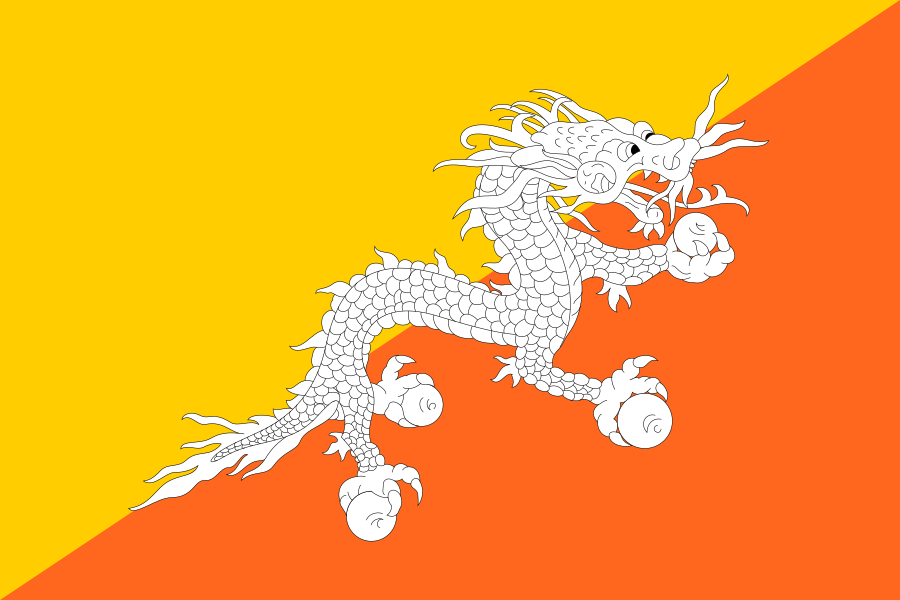

Bhutanese passport holders need a Malaysia eVisa approved before departure. The whole application is online — useful when the nearest Malaysian mission is accredited from New Delhi rather than resident in Thimphu.
30 days
Maximum stay per visit
90 days
eVisa validity from approval
3–7 days
Typical processing time
Any port
Entry point accepted
100% online
No embassy visit
Overview
Bhutan and Malaysia have a warm if small-scale relationship, built on Buddhist connections, education links and a steady flow of Bhutanese students and professionals to Malaysian universities and companies. For Bhutanese travellers Malaysia offers something Bhutan does not — coastline, large cities, and a shopping and medical infrastructure that draws visitors from across the region — all within a day's travel via Bangkok or Delhi.
Bhutan is on Malaysia's visa-required list, so an approved visa is needed before boarding. The eVisa handles tourist and business visits entirely online, which matters more for Bhutan than for most countries: Malaysia has no resident mission in Thimphu, and the accreditation runs from the High Commission in New Delhi. Without the online route, a straightforward holiday would mean corresponding with a mission in another country.
Applications from Bhutan are generally straightforward. Volumes are small, the traveller profile is typically well documented, and the standard evidence — passport, photograph, return ticket, accommodation and funds — is usually enough. The complications, where they arise, tend to be about routing rather than paperwork, because there is no direct flight and the connection has its own transit rules.
At a glance
Eligibility
Yes — every Bhutanese citizen needs a visa to enter Malaysia, for any purpose and any duration. There is no visa on arrival at Kuala Lumpur and no exemption that permits leaving the airport during a transit.
For tourism, visiting family and business travel, the eVisa covers it. The Single Entry Tourist eVisa suits a normal holiday; the Business eVisa covers meetings, conferences and trade fairs with an invitation from the Malaysian company; the Multiple Entry eVisa suits itineraries that enter Malaysia more than once.
Check your transit country as well as your destination. Because there is no direct Bhutan–Malaysia service, every journey passes through a third country — usually Thailand, India, Nepal or Singapore. Bhutanese passport holders should confirm the transit rules for that country separately, particularly on itineraries that involve changing airports, collecting baggage between separate tickets, or an overnight stop.
Study is a separate route. A course at a Malaysian institution requires a Student Pass arranged through the university and Education Malaysia Global Services well before travel. This is a well-used pathway from Bhutan and it cannot be converted from a tourist eVisa after arrival.
Every traveller needs their own eVisa, including babies and children, each tied to that person's own Bhutanese passport. A child cannot be added to a parent's application.
Which one to choose
Three products, all applied for the same way online. The right one depends on how many times you intend to enter Malaysia and why you are going.
A one-off holiday, a family visit, or a first trip to Malaysia.
Regional itineraries that dip in and out of Malaysia, and frequent visitors.
Meetings, conferences, trade fairs and site visits. Not valid for paid work.
Stay & validity
A Single Entry Tourist eVisa is valid for 90 days from approval — the deadline by which you must arrive in Malaysia. Once you enter, you are granted a stay of up to 30 days, stamped in your passport at the counter. The two periods are different and confusing them causes accidental overstays.
The Multiple Entry eVisa runs for three or six months from approval with unlimited entries, each visit capped at 30 days. Given that Bhutanese itineraries almost always route through Bangkok or Delhi, it is worth considering if your plans involve leaving Malaysia and returning.
Your Bhutanese passport must have at least six months of validity from your arrival date and at least one blank page for the stamp. The eVisa is tied to the passport number and does not transfer to a renewed document — a reissued passport means a fresh application with no refund.
The eVisa cannot be extended once issued. To stay beyond the 30 days you must leave Malaysia and apply again from outside. Nothing can be arranged at an immigration office inside the country.
Overstaying carries compound fines charged per day, escalating to detention, deportation at your own cost and a re-entry ban. Read the date written on your entry stamp before you leave the counter — it is the only record of when you must go.
Pricing
Live fees for Bhutanese passport holders, shown all-in — the Malaysian government charge and our service fee together, with nothing added later.
Your nationality is pre-selected as Bhutan
Requirements
Everything Bhutanese passport holders need before starting an application. The first five items apply to every applicant; the rest are specific to your nationality.
Passport bio-data page — a clear colour scan showing your photograph, full name, date of birth, passport number and expiry date, with at least six months of validity remaining
Recent passport-style photograph — white background, full face visible, taken within the last six months, with no headwear other than for religious reasons
Confirmed return or onward flight ticket showing you will leave Malaysia within the permitted stay
Proof of accommodation for the whole of your visit — hotel bookings, or an invitation letter and address if you are staying with family or friends
A credit or debit card to pay the Malaysian government fee and our service fee together, plus an email address you can access while travelling
Simple process
Four steps, entirely online, with our team checking every field before anything reaches Malaysian Immigration.
Enter your passport details exactly as printed, choose your visa type and upload your photograph and supporting documents. Most applicants finish in under fifteen minutes.
Our team checks your photograph, passport number, name spelling, itinerary and supporting documents against Malaysian Immigration requirements before anything is submitted.
Your application goes to the Department of Immigration Malaysia with the government fee paid, and we track its status until a decision is issued.
The approved eVisa is emailed to you as a PDF. Print a copy and keep it with your passport — airlines and immigration officers both ask to see it.
Malaysia eVisa applications from Bhutan are typically decided within three to seven working days. Volumes are low and applications are usually well documented, so most move through without a query.
Apply at least two to three weeks before travelling. The longer buffer is about the routing rather than the visa — Bhutanese itineraries depend on connections through Bangkok, Delhi or Kathmandu, and Paro's schedule is limited and weather-dependent enough that rebooking a leg is genuinely disruptive.
Sort the transit question at the same time as the visa. A Malaysian eVisa says nothing about your right to pass through Thailand or India, and an itinerary that requires collecting baggage and re-checking between separate tickets means formally entering the transit country. Confirm both before booking.
Bhutan is two hours behind Malaysia, so a query raised in Kuala Lumpur during working hours reaches you the same morning. Watch the email address you applied with, including its spam folder.
On arrival
An approved eVisa gets you on the plane. This is what happens once you land — including the arrival card that catches out more travellers than the visa itself.
Every traveller must submit the MDAC online within three days before arrival. It is not part of the eVisa, it is not optional, and airlines increasingly check it at the gate. It takes a couple of minutes and must be done for each traveller individually.
Malaysia issues the eVisa as a PDF rather than attaching it to the passport chip. Airline staff at check-in and the immigration officer on arrival both ask to see it, so carry a printed copy as well as the file on your phone.
The automated gates at KLIA are for Malaysian citizens, residents and a small number of registered categories. Visitors arriving on an eVisa are seen at a staffed counter, where the passport is stamped with the date of entry.
The officer may ask where you are staying, how long you intend to remain and how the trip is funded. Having your hotel booking, return ticket and, if you are visiting family, their address to hand makes this a thirty-second conversation.
Flying from Kuala Lumpur to Kota Kinabalu or Kuching means passing through immigration again on arrival, even though it is a domestic flight. Your eVisa covers it, but keep your passport accessible rather than packed.
The stamp records the date you entered and the date by which you must leave. Overstaying in Malaysia carries fines, detention and a re-entry ban, and the stamp is the only record of your deadline — so read it while you are still at the counter.
Getting there
There is no direct service between Bhutan and Malaysia. Drukair and Bhutan Airlines connect Paro to Bangkok, Delhi, Kathmandu, Kolkata and Singapore, and each of those is a one-stop point onward to Kuala Lumpur. Bangkok and Singapore are usually the smoothest connections; Delhi offers the widest choice of onward fares.
Best time to go
The climate contrast is the largest of any country on this list. Bhutan is a Himalayan country with cold winters and cool highland summers; Malaysia is tropical, humid and between roughly 25°C and 33°C in every month at sea level. Expect the humidity to be the real adjustment rather than the temperature figure alone.
December to March is the best window overall — it is the driest period on the Kuala Lumpur, Penang and Langkawi west coast, and it coincides with Bhutan's winter when leaving the cold is most appealing. Flight connections through Bangkok and Delhi are also at their most reliable then.
Avoid tying travel to Paro's monsoon months of June to August if you can. Bhutan's own weather affects departures more than Malaysia's does — Paro is a demanding airport with visual approach requirements, and delays there cascade into missed connections at Bangkok or Delhi. Building a longer transit buffer in those months is sensible.
The east coast islands, including the Perhentians, Redang and Tioman, close under the monsoon from November to February. If beaches are the point of the trip, the west coast works in those months, or shift the dates to between March and September for the east.
Avoid these
Most refusals are avoidable and technical rather than substantive. These are the problems that come up most often on applications from Bhutan — we check for every one of them before submitting.
Every journey from Bhutan to Malaysia connects somewhere. A Malaysian eVisa says nothing about your right to transit Thailand, India, Nepal or Singapore, and separate tickets that require collecting baggage mean formally entering the transit country. Confirm both sets of rules before booking.
Paro's schedule is limited and its approach is weather-dependent, so departures slip more often than at most airports. A two-hour connection in Bangkok or Delhi that works on paper can fail in practice. Build a longer buffer, particularly in the June to August monsoon.
The eVisa's 90-day validity is the window in which you must arrive. The stay granted at the counter is up to 30 days. Reading the first as the second is the most common route to an accidental overstay.
Malaysian universities are a well-used destination from Bhutan, and the Student Pass must be arranged through the institution and EMGS before travel. It cannot be converted from a tourist eVisa after arrival, so the process has to start months earlier.
Bhutanese itineraries involve multiple carriers and often separate tickets, which makes rebooking expensive and awkward. Wait for the approval before committing to the whole chain.
The MDAC is separate from the eVisa and required for every traveller, submitted online within three days before arrival. Your connecting airline may check it at the gate, so submit it before you leave the transit airport.
Passport number mistyped
By far the most common problem. The eVisa attaches to the number you enter, so a single wrong character produces an approval that does not match the document you present at check-in.
Insufficient proof of funds
Malaysian Immigration wants to see that you can support yourself for the whole visit. Thin statements, a balance deposited in a lump sum days before applying, or no statements at all are the leading cause of refusal.
A photograph that fails the check
Shadows across the face, a coloured or patterned background, glasses, or a scan cropped too tightly all cause rejection. Malaysia is stricter than most on the plain white background requirement.
Conditions
These conditions are set by the Department of Immigration Malaysia and do not vary by nationality. The 90-day validity and the 30-day stay are different things, and confusing them is the most common misreading of the whole scheme.
Your approval is issued against the passport number you enter. If you renew or replace that passport before travelling, the eVisa does not transfer — you must apply again on the new document, and there is no refund on the old one.
Every person travelling needs their own eVisa, including babies and children. A child cannot be added to a parent's application, and each traveller needs their own valid passport to apply against.
A Single Entry eVisa is valid for 90 days from the date it is approved, and that is the window in which you must arrive. The stay it grants once you enter is separate and shorter — up to 30 days. The two are routinely confused.
The Malaysia eVisa is not extendable. If you want to stay longer you must leave the country and apply again from outside. Building an extension into your plans is not an option, so book the trip you actually intend to take.
Unlike India's eVisa, Malaysia's is not restricted to designated airports. You may enter through any authorised international airport, seaport or land checkpoint, which makes overland arrivals from Thailand and Singapore straightforward.
An approved eVisa gets you on the plane. The decision to admit you is made by the immigration officer on arrival, who can ask about your funds, your accommodation, your onward ticket and the purpose of your visit.
Consular services
Malaysia does not maintain a resident high commission in Thimphu; accreditation for Bhutan runs from the Malaysian High Commission in New Delhi, with honorary consular representation locally. This is precisely why the online route matters here — the eVisa application is completed online and decided digitally, with no interview, no appointment and no passport submission, so a straightforward holiday never requires corresponding with a mission in another country.
FAQs
The questions Bhutanese passport holders ask most often about travelling to Malaysia.
Yes. Bhutan is on Malaysia's visa-required list, so an approved visa is needed before boarding for any purpose and any length of stay. For tourism and business the eVisa is applied for entirely online, which matters here because Malaysia has no resident mission in Thimphu.
No. Every route connects, usually through Bangkok, Delhi, Kathmandu, Kolkata or Singapore. Drukair and Bhutan Airlines serve those points from Paro, and Malaysia Airlines, AirAsia and Batik Air operate onward to Kuala Lumpur. Total journey time is around 10 to 14 hours depending on the connection.
That depends on the country you connect through, not on Malaysia. A Malaysian eVisa gives you no rights in Thailand, India, Nepal or Singapore. Check the transit rules for your connecting country separately, especially if your tickets are separate and you must collect and re-check baggage, which means formally entering that country.
Up to 30 days per entry, stamped in your passport on arrival. The eVisa's 90-day validity is the deadline by which you must arrive rather than the length of your stay, and the 30 days cannot be extended from inside Malaysia.
Typically three to seven working days. Volumes from Bhutan are low and applications are usually well documented, so most are decided without a query. Apply two to three weeks ahead — the extra buffer is for the flight connections rather than the visa itself.
A passport valid six months beyond arrival, a confirmed return ticket, hotel bookings or an invitation letter, three months of bank statements, a white-background photograph and a travel itinerary showing your route including the transit point. Business travellers also need an invitation from the Malaysian company.
No. A course at a Malaysian institution requires a Student Pass arranged through the university and Education Malaysia Global Services before travel. It cannot be converted from a tourist eVisa after you arrive, so the application needs to start months in advance.
Yes. The Multiple Entry eVisa is valid for three or six months from approval and allows unlimited entries, each capped at 30 days. Because Bhutanese itineraries route through Bangkok or Singapore anyway, it is worth considering if your plans involve leaving Malaysia and coming back.
Yes. Every traveller needs their own eVisa regardless of age, including babies, each tied to that person's own Bhutanese passport. A child cannot be added to a parent's application.
Yes. The MDAC is a separate online form submitted within the three days before you arrive, and the eVisa does not cover it. Each traveller submits their own, including children. Submit it before leaving your transit airport, as connecting airlines increasingly check it at the gate.
Your nationality is already set to Bhutan. Complete the form in under fifteen minutes, and our team will check every detail before it reaches Malaysian Immigration.
Other nationalities
Requirements, supporting documents and routes differ by passport. Here are the guides for other eligible nationalities.