
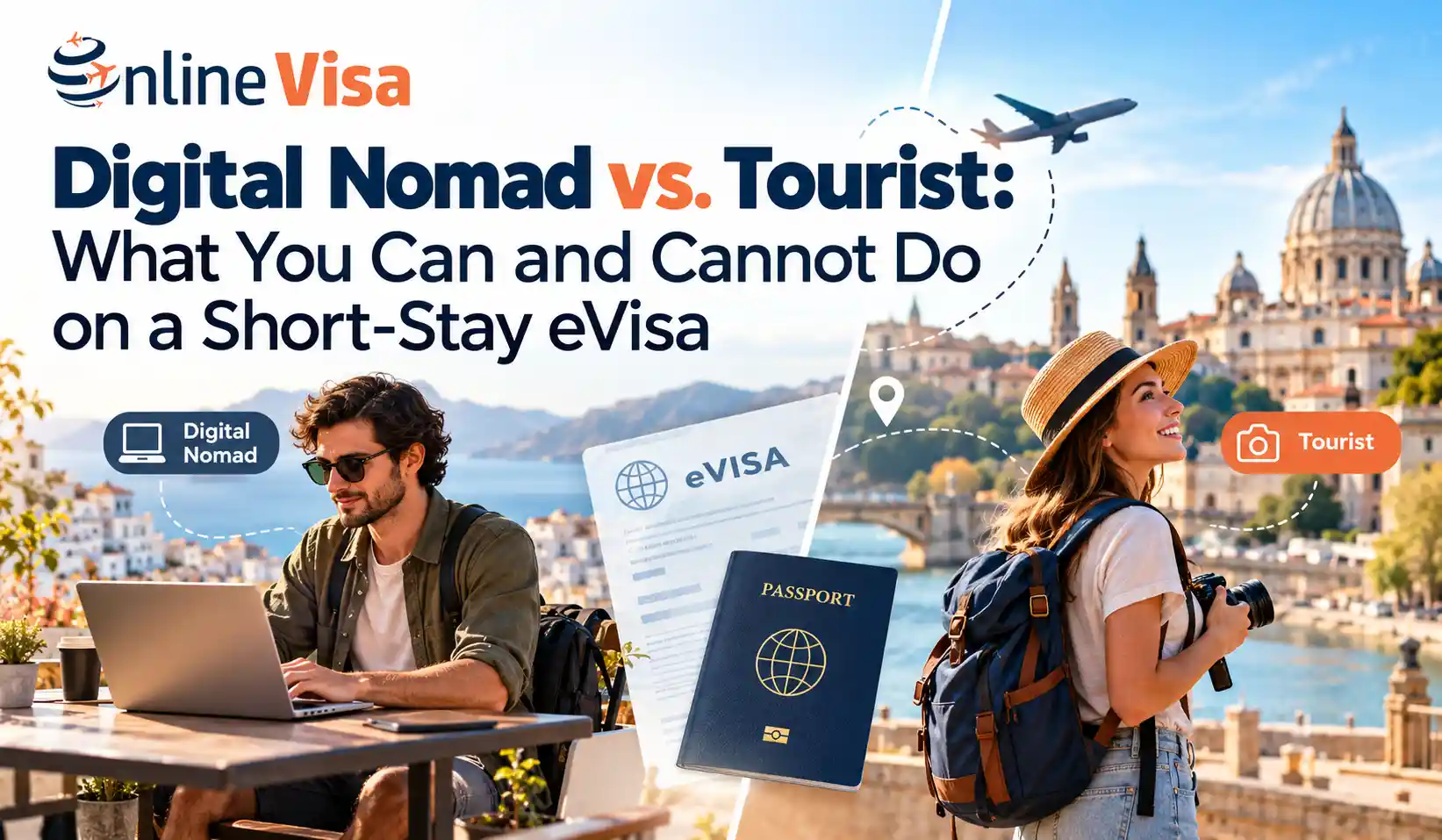
Digital Nomad vs. Tourist: What You Can and Cannot Do on a Short-Stay eVisa
Digital Nomad vs. Tourist explained: learn what you can and cannot do on a short-stay eVisa and choose the right visa. Check requirements now.
Before you book your flight or start working from a beach café, it is important to understand what your visa actually allows.
Digital Nomad vs. Tourist: What Is the Difference?
The biggest difference is the purpose of your stay.
A tourist normally visits another country for holidays, sightseeing, visiting friends or family, or other permitted short-term activities.
A digital nomad, on the other hand, usually travels while continuing to work remotely for an employer, clients, or a business based outside the destination country.
These activities can look similar from the outside because both travellers may stay for a few weeks or months. However, immigration rules can treat them very differently.
Important: There is no universal rule saying that every tourist eVisa allows remote work. The legal position depends on the destination, nationality, visa category, and nature of the work.
Can You Work Remotely on a Tourist eVisa?
This is one of the most common questions about Digital Nomad vs. Tourist visas.
The safe answer is: do not assume that you can.
A tourist visa or eVisa is generally designed for permitted visitor activities, not employment in the destination country. Some countries may tolerate or specifically allow certain forms of remote work, while others require a dedicated digital nomad, remote-work, business, or employment visa.
Before working remotely, check:
-
The exact conditions of your visa
-
Whether remote work is permitted
-
Whether your employer must be outside the country
-
Whether local clients are allowed
-
Whether you can receive income while physically present there
-
How long you can remain in the country
-
Whether tax or registration rules apply
If you are unsure, contact the relevant immigration authority or obtain professional immigration advice.
What Can a Tourist Usually Do?
A short-stay tourist eVisa is normally intended for activities such as:
-
Sightseeing and tourism
-
Visiting attractions
-
Taking a holiday
-
Visiting friends or family, where permitted
-
Staying in hotels, resorts, or other accommodation
-
Participating in permitted cultural or recreational activities
-
Travelling around the country within the visa conditions
However, the exact list varies by destination.
For example, an eVisa can give a traveller permission to enter a country, but it does not necessarily give them permission to accept local employment or provide services to a local business.
Always read the conditions attached to your specific visa.
What About Digital Nomads?
A digital nomad generally works online while living temporarily outside their home country.
For example, imagine you are travelling from the USA and work remotely for a US-based software company. You plan to spend six weeks in another country while continuing your normal job online.
That does not automatically make your trip a tourist trip for immigration purposes.
The destination may have a specific remote-work or digital-nomad permission, or it may have rules that determine whether your activities are permitted under another visa category.
This is why checking the visa rules before travelling is important.
Digital Nomad vs. Tourist: Quick Comparison
| Activity | Tourist eVisa | Digital Nomad/Remote Work Visa |
| Sightseeing | Usually permitted | Usually permitted |
| Holiday travel | Usually permitted | Usually permitted |
| Hotel or short-term accommodation | Usually permitted | Usually permitted |
| Working for a local employer | Generally not permitted | Depends on visa |
| Remote work for an overseas employer | Depends on destination | Often specifically addressed |
| Providing services to local clients | Usually restricted | Depends on visa conditions |
| Long-term residence | Usually not permitted | May be possible under conditions |
| Local employment | Generally not permitted | Usually requires specific permission |
This table is a general guide, not a substitute for the immigration rules of your destination.
What You Cannot Assume From an eVisa
An eVisa is an electronic travel document or authorisation, but the word "eVisa" does not describe what activities you can perform.
Two countries can both offer eVisas while having completely different rules.
For example, one destination may offer a tourist eVisa for short visits, while another may offer a separate digital-nomad visa specifically for remote workers.
So, never assume:
-
“I can work because I have a valid eVisa.”
-
“My job is online, so immigration rules do not apply.”
-
“My employer is in another country, so remote work is automatically legal.”
-
“I am only staying for 30 days, so I do not need permission.”
-
“I can work for local clients because I am not being paid locally.”
The correct answer depends on the destination's immigration regulations.
Can You Attend Business Meetings on a Tourist Visa?
This is another area where travellers need to be careful.
Some countries allow visitors to attend meetings, conferences, negotiations, or other limited business activities without requiring a work visa.
Other activities may require a business visa or another form of permission.
For instance, attending a meeting with an overseas business partner could be treated differently from taking a local job, providing hands-on services, or working for a company in the destination country.
If business is part of your trip, check the destination's specific business-visitor rules before travelling.
What Happens If You Work Without Permission?
Working without the correct immigration permission can create serious problems.
Depending on the country and circumstances, consequences may include:
-
Visa cancellation
-
Refusal of entry
-
Fines or penalties
-
Removal or deportation
-
Problems with future visa applications
-
Immigration or tax complications
Even if you only plan to work for a few hours each day, do not assume that the activity is automatically permitted.
The safest approach is to identify the correct visa category before departure.
How to Choose the Right Visa
If you are deciding between a tourist eVisa and a digital-nomad or remote-work option, start by answering these questions:
1. Why are you travelling?
If the main purpose is a holiday, a tourist visa may be appropriate where available.
If the main purpose is to live temporarily while working remotely, investigate whether the destination offers a specific remote-work or digital-nomad option.
2. Who pays you?
Determine whether your income comes from an overseas employer, your own overseas business, or clients in the destination country.
3. How long will you stay?
A short holiday and a several-month remote-work stay can fall under different immigration rules.
4. Are you working for local businesses?
This can be particularly important. Local employment or providing services to local clients may require additional permission.
5. Check the latest official requirements
Immigration rules can change. Always check the latest requirements for your nationality and destination before submitting an application.
If you want help navigating the application process, you can visit OnlineVisa to check available visa services and application requirements. OnlineVisa provides online application assistance, expert review, and application support for destinations listed on its platform.
A Simple Example: Tourist vs. Remote Worker
Imagine two travellers arriving in the same country.
Traveller A arrives from the USA for a two-week holiday. They visit museums, explore cities, stay in hotels, and return home after their trip.
Traveller B also arrives from the USA but plans to stay for three months while working every weekday for their US-based company.
Although both travellers may enter through the same airport, their immigration situations can be different because the second traveller intends to work remotely during the stay.
That is why Digital Nomad vs. Tourist is not simply a question of how long you stay. The purpose and activities of your trip matter too.
Final Thoughts on Digital Nomad vs. Tourist
The key lesson from the Digital Nomad vs. Tourist comparison is simple: a tourist visa should not automatically be treated as a work permit.
An eVisa may make the application and entry process easier, but it does not override the conditions set by the destination country's immigration authorities.
If you plan to work remotely, check whether your destination specifically permits digital-nomad or remote-work activities. If you are travelling only for tourism, make sure your activities match the conditions of your tourist visa.
Before you travel, check the latest requirements for your nationality and destination and make sure you select the correct visa category.
Frequently Asked Questions
Can I work remotely on a tourist eVisa?
It depends on the country and visa conditions. Do not assume remote work is permitted simply because your employer is overseas.
Is a digital nomad visa the same as a tourist visa?
No. A digital nomad or remote-work visa is generally designed for people who want to work remotely while staying temporarily in another country. A tourist visa is primarily intended for visitor activities.
Can I attend business meetings on a tourist eVisa?
Some destinations permit limited business-visitor activities, such as meetings or conferences, but the rules vary. Check the specific requirements before travelling.
What happens if I work without the correct visa?
Depending on the destination, unauthorised work can result in penalties, visa cancellation, removal, or problems with future immigration applications.
Ready to Apply?
Planning a trip and not sure which travel document you need? Check your destination and visa requirements before booking your journey.
Apply Now with OnlineVisa and get guided assistance with your online visa application. OnlineVisa says applications can be completed online, with expert review and support throughout the process.
Related Articles
 Travel & Visa News
Visa Interview Questions and Answers: Complete Guide to Success
 Travel & Visa News
Japan Visa Processing Time for Indians: Complete 2026 Timeline
 Travel & Visa News