
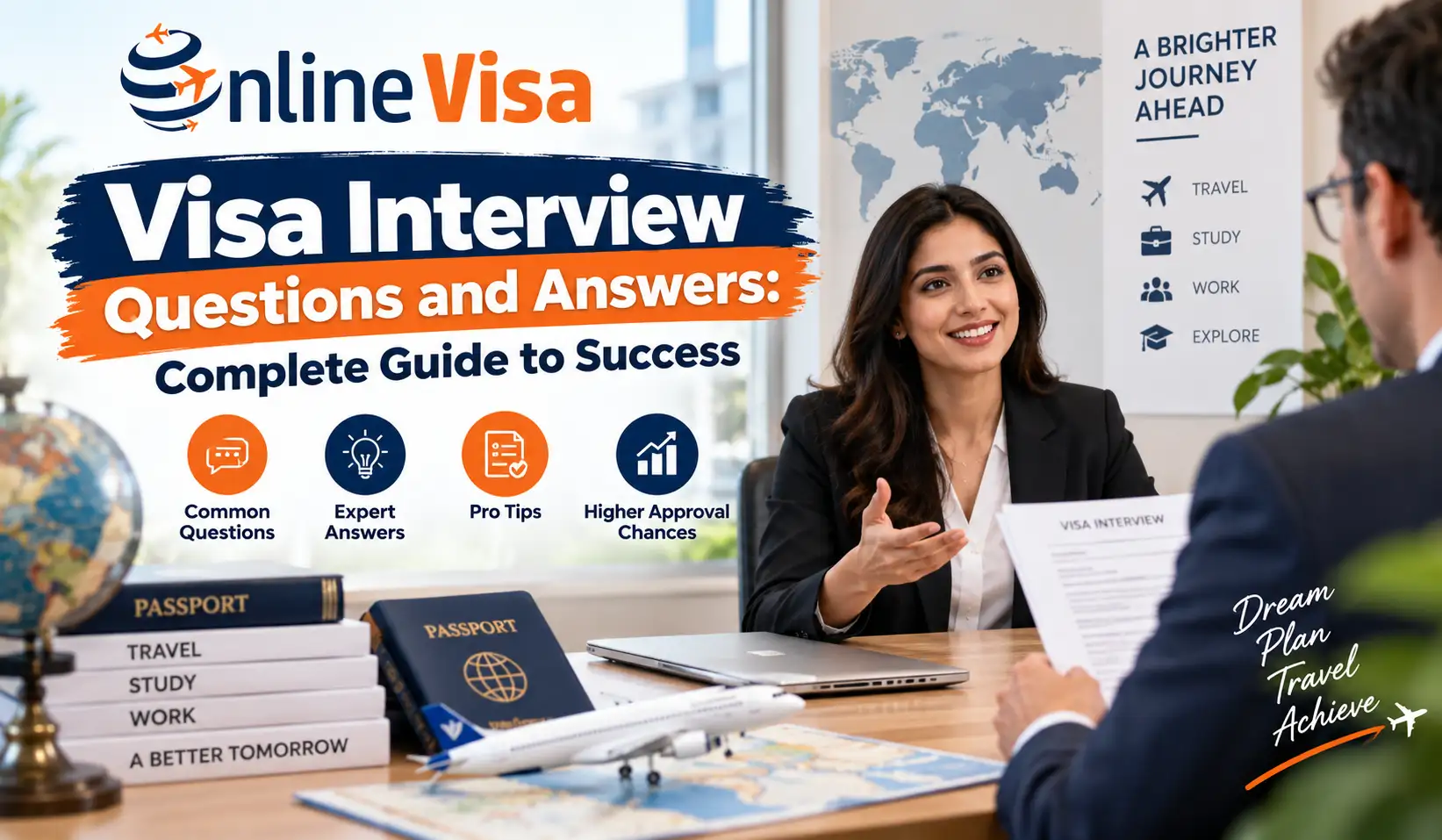
Visa Interview Questions and Answers: Complete Guide to Success
Master your visa interview with expert tips on common questions, what to expect, and how to avoid red flags. Learn strategies used by successful applicants.
Visa Interview Questions Are Easier When You're Prepared
About one in four visa applicants faces rejection at their interview—not because their documents are weak, but because they stumble during the conversation itself. The good news: visa interview questions follow predictable patterns, and you can prepare solid answers in advance.
Most interviews last just 2–5 minutes, but in that brief window, the consular officer decides whether you're a genuine visitor who will return home. They're not trying to trick you. They want to verify your story matches your paperwork and that you're being honest.
What to Expect at Your Visa Interview
Understanding the format and atmosphere removes anxiety and helps you perform better. Here's what actually happens:
The Interview Environment
You'll stand or sit across from a consular officer at a desk, usually separated by protective glass. The setting is formal but not hostile. The officer has your application file and will reference it during questions. Most interviews feel like a professional conversation, not an interrogation.
Typical Duration and Question Count
Expect 5–10 questions on average. Some interviews are shorter (under 2 minutes), while others, particularly for work visas or second-time applicants with complications, can stretch to 10 minutes. The officer controls the pace and flow.
How Officers Evaluate You
The decision is based roughly 80% on your verbal answers and demeanor, 20% on your documents. This means:
- Confidence and clarity matter more than perfection
- Consistency between your answers and your DS-160 application is critical
- Your tone, eye contact, and body language influence the outcome
- Hesitation or contradictions raise suspicion
Most Common Visa Interview Questions and Strong Answers
Consular officers ask variations of the same core questions across visa types. Here are the ones you'll almost certainly face, with guidance on how to answer:
Why Are You Visiting [Country]?
What they're checking: Is your stated purpose genuine? Do you have a clear plan? Are you hiding something?
How to answer: Be specific and brief. Instead of "tourism," say "I'm attending my cousin's wedding in New York and planning to visit Niagara Falls and the Statue of Liberty." For business: "I'm attending the International Tech Conference in Boston as a speaker for my company."
How Long Will You Stay?
What they're checking: Does your timeline match your stated purpose? Is it realistic?
How to answer: Give a specific number of days, not vague language. "I'll be here for 10 days" is better than "a week or so." Make sure it aligns with your flight bookings and itinerary.
Who Is Sponsoring Your Trip? / How Will You Pay?
What they're checking: Do you have genuine financial support? Will you burden the country's social services?
How to answer: If self-funding: "I've saved $5,000 for this trip. I have bank statements showing my savings." If sponsored: "My brother, who lives in Boston and works as an engineer, is hosting me. I have his employment letter and bank statements showing he can support me."
Where Will You Stay?
What they're checking: Do you have a concrete plan? Are you stable enough to manage logistics?
How to answer: Name the specific hotel, Airbnb, or host's address. "I'm staying at the Marriott downtown from June 5–12" is far better than "with friends somewhere." Have the confirmation ready to show.
What Do You Do for Work/School?
What they're checking: Do you have ties to your home country? Will you return?
How to answer: Be detailed but concise. "I'm a software engineer at TechCorp in São Paulo. I've worked there for three years. My manager approved two weeks of leave for this trip." This shows you have a job to return to.
Have You Traveled Abroad Before?
What they're checking: Are you an experienced traveler? Have you followed the rules in the past?
How to answer: List previous trips briefly. "Yes, I've been to Argentina twice, Chile once, and Spain for a week. All within the last five years." If you haven't traveled: "No, but I'm organized and have researched all requirements for this trip."
Tell Me About Your Family.
What they're checking: Do you have close ties that would bring you back home?
How to answer: Mention immediate family and their roles. "I'm married with two children. My wife works as a doctor; my kids are in school. My parents also live nearby." This builds a picture of your roots.
Visa-Specific Interview Question Strategies
B1/B2 Tourist and Business Visa Interview Tips
For tourist visas, officers focus on your ability to pay and your ties to home. Have detailed itineraries, flight bookings, and hotel confirmations ready. Be prepared to explain why you chose your destination and what you'll do there.
For business visas, they want proof of genuine business activity. Bring your company's invitation letter, conference registration, or client contract. Explain your role in the meeting and expected outcomes.
F1 Student Visa Interview Questions
Student visa interviews are more rigorous because officers verify academic intent and financial capacity. Prepare answers to:
- Why this specific school and program? (Show genuine interest, not just "it's ranked well)
- How will you pay for tuition? (Reference I-20, sponsor letters, bank statements)
- What will you do after graduation? (Career plans back home)
- Why not study this in your home country? (Legitimate reasons tied to program quality)
Bring your I-20 form, SEVIS receipt, school acceptance letter, and sponsor's financial documents.
UK Visa Interview Process
UK interviews are less common but follow similar logic. Tourist visa questions focus on your itinerary, accommodation, and funds. UK visa interview red flags include vague travel plans, insufficient funds, or answers that contradict your online application. The UK Home Office places heavy weight on your online visa application answers, so consistency is paramount.
How to Prepare Your Visa Interview Answers
Don't memorize scripts. Instead, prepare talking points and practice delivery. Here's a proven method:
- Write down answers to common questions (keep notes under 50 words per answer)
- Read aloud three times to hear how you sound
- Practice with a friend or in front of a mirror, aiming for natural conversation tone
- Record yourself to check for filler words (uh, um, like) and body language
- Review your DS-160 or application form the night before to ensure consistency
The goal is to sound confident and genuine, not robotic. If you pause briefly to think, that's fine. If you say "Let me think for a moment," that's honest and acceptable.
Visa Interview Red Flags to Avoid
Consular officers spot inconsistencies and evasion quickly. Avoid these costly mistakes:
- Contradicting your application: If your DS-160 says you're a teacher but you tell the officer you're self-employed, your credibility collapses
- Vague or evasive answers: "I don't know" or "I'm not sure" on basic questions raises suspicion
- Changing your story: If you mention a detail to the officer that wasn't on your application, explain it naturally ("I forgot to mention") rather than acting defensive
- Poor financial preparation: Not knowing your bank balance or sponsor's details undermines your credibility
- Dismissing the interview: Acting like questions don't matter or being rude destroys your chances
- Admitting intent to work on a tourist visa: If applying for B1/B2, never say you plan to work. That's visa fraud
- Lying about travel history: Officers check passport stamps. Omitting countries or dates is an immediate red flag
Dress Code and Body Language for Your Interview
First impressions form in 30 seconds. Dress professionally:
Men: Dress shirt and slacks at minimum; suit and tie preferred, especially for work visas. Shoes should be clean and polished.
Women: Blouse with dress pants or skirt, dress suit, or equivalent business attire. Closed-toe shoes are standard. Keep jewelry modest.
For all applicants: Avoid jeans, t-shirts, shorts, athletic wear, and excessive cologne or perfume. Dress as you would for an important job interview.
Body Language Tips
Your nonverbal communication matters as much as your words:
- Make steady eye contact with the officer
- Stand or sit upright; don't slouch
- Speak clearly at a moderate pace
- Use natural hand gestures (avoid fidgeting)
- Smile briefly when greeting and closing
- Answer in complete sentences, not single words
Before Your Interview: Essential Preparation Checklist
Start preparing at least 1–2 weeks before your appointment. Use this checklist:
| Task | Deadline |
|---|---|
| Print DS-160/application confirmation | 2 weeks before |
| Review all application answers for consistency | 2 weeks before |
| Organize supporting documents in a folder | 1 week before |
| Practice answers to common questions | 1 week before |
| Verify your embassy's document requirements | 1 week before |
| Plan your interview day route and arrival time | 3 days before |
| Confirm interview appointment details | 2 days before |
| Review your answers and travel itinerary | Night before |
Day-of Interview Tips
Execution matters as much as preparation. Here's how to perform on the day:
- Arrive 30 minutes early — embassy security can cause delays
- Eat a proper breakfast — low blood sugar impairs performance and confidence
- Bring only essentials — a small folder with documents, your passport, and phone (off, unless required)
- Use the bathroom before — you won't have a chance during the interview
- Take a deep breath — calm yourself before entering; the officer wants you to succeed
- Listen carefully — hear the full question before answering; don't interrupt
- Be honest — if you don't know the answer, say so rather than guessing
- Stay positive — even if a question seems accusatory, respond cooperatively
Frequently Asked Questions About Visa Interviews
What documents must I bring to my visa interview?
Always bring your valid passport, interview appointment confirmation, DS-160 confirmation page (for US visas), and visa fee receipt. Additionally, bring supporting documents organized in a folder: bank statements (3–6 months), employment letter, flight bookings, hotel reservations, and any purpose-specific documents like I-20 (students), invitation letters (business/family), or conference registration. Check your specific embassy's requirements beforehand.
Can I bring my phone or electronic devices to the visa interview?
Most US embassies prohibit phones, laptops, smartwatches, and USB drives. Check your embassy's security policy before your appointment. If you need to reference digital documents, print them in advance. Some embassies may allow phones but require them to be powered off during the interview.
How long does a typical visa interview take?
The actual interview lasts 2–10 minutes, though the total time at the embassy (including security, queuing, and processing) can be 1–3 hours. Factor in travel time and arrive early. Individual interviews vary; some are very brief if the officer is satisfied quickly, while others take longer if complications arise.
What if I don't understand a question during my visa interview?
It's completely acceptable to ask the officer to repeat or clarify. Say, "Could you please rephrase that?" or "I didn't quite understand. Could you explain again?" This is far better than guessing and giving a wrong answer. Officers expect to work with applicants from diverse language backgrounds.
Can I bring someone with me to my visa interview?
Most embassies do not allow companions in the interview room itself. However, family members or friends can accompany you to the embassy for support. If you're a minor or have a disability, contact your embassy beforehand about accessibility accommodations. Interpreters are sometimes available; request one in advance if you don't speak the interview language fluently.
What happens if my visa is denied at the interview?
You'll receive a written notice of denial explaining the reason. Common reasons include insufficient ties to your home country, inconsistencies in your application, lack of financial proof, or visa fraud concerns. You can apply again, but you must address the stated reason. Many applicants reapply successfully after strengthening their case (more financial documents, additional ties to home, clearer purpose).
Should I prepare a written statement or speech for my visa interview?
No. The officer wants a conversation, not a rehearsed speech. Preparing talking points (not full scripts) and practicing natural delivery is the right approach. If you sound overly rehearsed or mechanical, it raises suspicion. Aim for genuine, conversational confidence.
Key Takeaways for Visa Interview Success
You're now equipped to approach your visa interview with confidence. Remember these core principles:
- Consistency is critical: Your verbal answers must match your online visa application and documents exactly
- Specificity builds credibility: Vague answers raise red flags; detailed plans demonstrate genuine intent
- Preparation replaces anxiety: Practice common questions, organize documents, and review your application the night before
- Your tone and demeanor matter: Confidence, honesty, and politeness influence the officer's decision as much as your words
- First impressions are lasting: Dress professionally, maintain eye contact, and speak clearly from the moment you greet the officer
- It's a conversation, not an interrogation: Officers want to verify your story is genuine; cooperate and be honest
Visa interviews aren't designed to trick you—they exist to confirm you're a genuine traveler. With proper preparation, clear answers, and a professional demeanor, you'll pass yours successfully.
Related Articles
 Travel & Visa News
Japan Visa Processing Time for Indians: Complete 2026 Timeline
 Travel & Visa News
UK Student Visa Maintenance Funds Increase November 2026: What You Need
 Travel & Visa News